


Healthcare websites, SEO and Google Ads for clinics, specialists and health brands
Websites for Doctors & Medical Specialists
A doctor's or specialist's website has one main job: to let a patient or a referring doctor confirm who you are, what you treat, where you consult and how to get an appointment. We handle doctor website design for GPs, surgeons and specialists, setting this out factually, under your own name, within your profession's advertising rules.
Two audiences: patients and referrers
A specialist's website is read by two groups, and they want different things.
Patients often arrive already holding your name. A GP, a family member or a medical scheme has pointed them to you, and they search for you by name to check who you are before they call. The site has to appear for that search and answer it quickly.
Referring doctors want to know your sub-specialty interests, where you operate or consult, and how to send a patient to you. Most specialist websites ignore them. We give referrers their own page.
What goes on a doctor or specialist website
- Your profile. Qualifications, registered category, training, sub-specialty interests and hospital affiliations. For academics, teaching posts and publications.
- Conditions and procedures. One page each for the conditions you treat and the procedures you perform: what it is, when it is considered, what to expect and what recovery involves. You write or sign off every one.
- Consulting rooms. Many specialists consult at more than one hospital or practice. Each location gets its own details: address, consulting days, parking and the right phone number for that room.
- Your first appointment. What to bring, whether a referral letter is needed and how your rooms handle accounts and medical scheme claims.
- For referring doctors. How to refer, what information you need and how to reach your rooms.
Writing about yourself within the rules
This is where a doctor's site differs most from other business websites. In South Africa, the HPCSA's ethical rules prohibit canvassing, which they define as drawing attention to one's personal qualities, superior knowledge or quality of service.
So a profile states facts and leaves the adjectives out. It lists what you are registered as, where you trained and what you treat. It does not call you the best, the top or the most experienced. We write to that standard and flag anything borderline for your decision. Other countries have their own regulators and rules.
This is general information, not legal advice. We give guidelines only and make no warranty that a website will be compliant. The practitioner confirms the final rules with the HPCSA, their own regulator or their own legal counsel.
Being found by name
Two things help a name search lead to you rather than to a directory listing.
The first is Google Business Profile. Google's guidelines allow an individual practitioner to have their own profile when they are public-facing and can be contacted directly at the verified location during stated hours. Where several practitioners share a location, the practice has its own profile and each practitioner's profile carries only the practitioner's name. A practitioner should not hold several profiles to cover different specialisations.
The second is structured data. Schema.org has a Physician type with properties for medical specialty and hospital affiliation, which lets us describe you and your rooms to search engines in a form they can read. Google does not guarantee that structured data will produce any particular search feature.
Both are part of local SEO. The wider method for health content is on our medical SEO page.
A small site, built properly
A solo practitioner usually needs a small site. We choose the platform to fit: WordPress when the site needs online booking or forms that your rooms manage, or Astro on Cloudflare for a simpler information site. Either way it is designed desktop-down, built to rescale to every screen size, and set up so your practice manager can update consulting days and contact details.
If you practise in a group, our clinic website design page covers multi-practitioner sites.
Who we work with
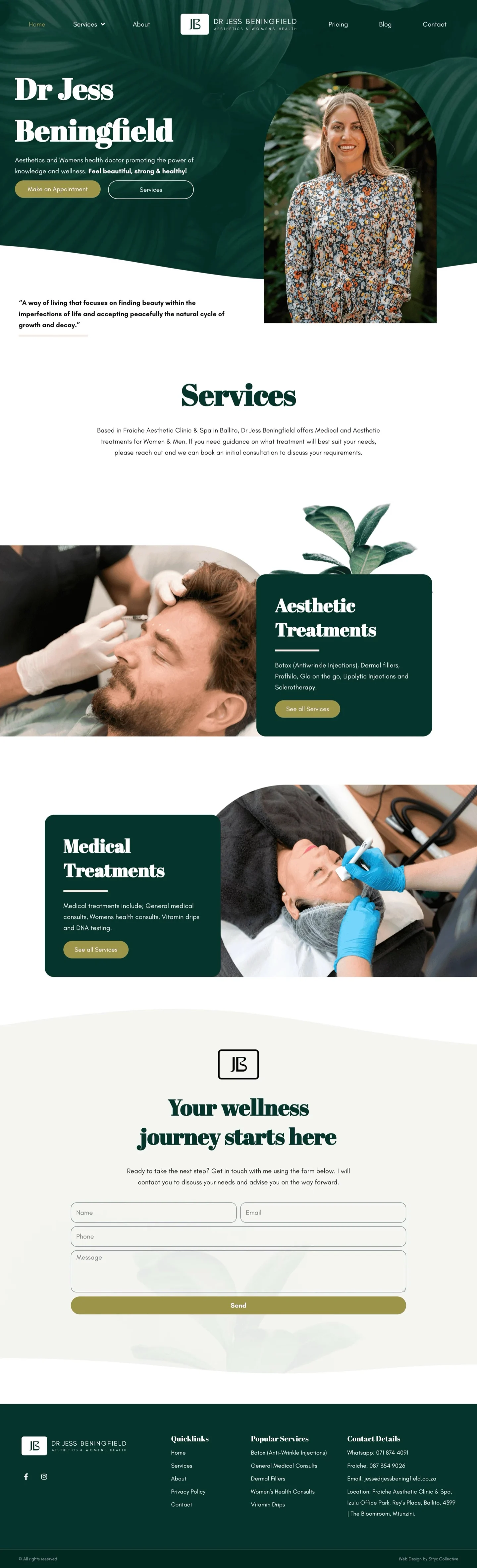
We work with Prof. Ali Noorani, an orthopaedic surgeon in London; Victoria Timm Psychologist, a counselling psychologist in Rivonia, Johannesburg; and Dr Jess Beningfield, an aesthetic medicine and women's health practice in Ballito.
See the healthcare overview for our wider work in the sector, or get in touch to talk about your own site. Quotes follow an initial discussion.
Clients in healthcare & clinics







Questions
Questions about Websites for Doctors & Medical Specialists
Can't see yours? Ask Ryan directly and you'll get a straight answer, usually the same day.
Ask on WhatsAppDoes a specialist need a website if patients come by referral?
Yes, in most cases. Referred patients commonly search for the specialist's name before they call, and a website you control answers that search with accurate details about your rooms, your fields of practice and how to book.
What can a doctor say about themselves on a website?
Facts: registered category, qualifications, training, fields of practice and where you consult. In South Africa the HPCSA's ethical rules prohibit canvassing, defined as drawing attention to personal qualities, superior knowledge or quality of service. Confirm the final wording with the HPCSA or your own counsel.
Can I have my own Google Business Profile as a doctor?
Google's guidelines allow an individual practitioner to have a profile when they are public-facing and directly contactable at the verified location during stated hours. Where several practitioners share a location, the practice and each practitioner have separate profiles.
I consult at more than one hospital. How do you handle that?
Each consulting location gets its own section or page with its address, consulting days, parking and the correct phone number, so patients contact the right rooms.
Who writes the condition and procedure pages?
Either you supply and approve the wording, or we research and write it and you verify and sign it off before it goes live. Nothing clinical is published without your sign-off.
Start a project
Be the business they find first
Tell Ryan what you sell and who buys it. You'll get a straight answer on what's holding your website back and what to fix first. There's no obligation to go ahead.
More enquiries you can trace. You'll see which search, page or ad brought in each call, booking and form.
Higher in search results. On Google, in the map results and in AI answers, for the searches your customers make.
One person to talk to. Ryan answers on WhatsApp and sends a plain-language report on results every month.
